In Focus: Progress on breaking the cycle of HIV transmission
Zack Panos


What would it actually take to end HIV, and how could new breakthroughs finally make this goal a reality? We asked Zack Panos, CIFF’s Senior HIV Integration and Access Manager, to break it down for us:
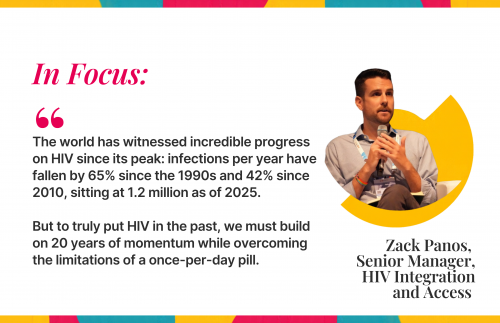
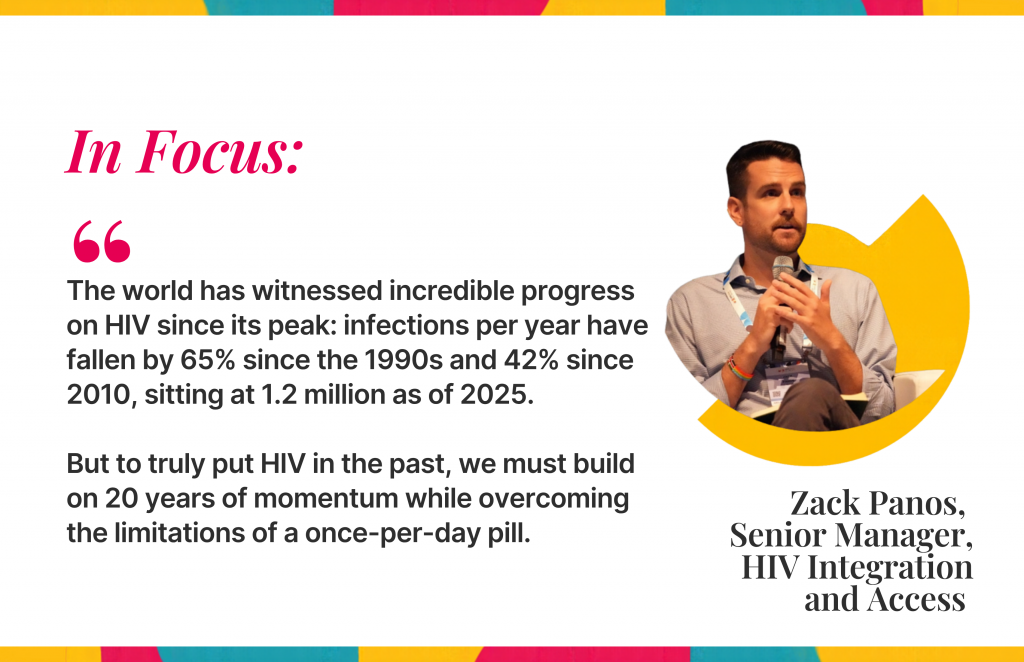
The world has witnessed incredible progress on HIV since its peak: infections per year have fallen by 65% since the 1990s and 42% since 2010, sitting at 1.2 million as of 2025.
However, progress has been limited by challenges in providing affordable and regular access to PrEP, especially in hard-to-reach communities. To truly put the HIV epidemic in the past, the challenge is to continue the past 20 years’ momentum while overcoming the limitations of a once-per-day pill.
The best way to do this is to expand our toolbox of treatment options, creating different ways to reach people where they are and meet their unique needs: for example, making medications as discreet as possible to avoid the social stigma associated with HIV, or finding longer-lasting options that do not require daily doses or monthly refills at a clinic. The good news is that governments and partners have a new tool at their disposal: lenacapavir (LEN), a once-every-six-month injection which provides HIV protection for half a year. LEN is uniquely capable of fixing today’s HIV prevention challenges because it doesn’t require daily use and is extremely effective.
LEN’s uptake is already promising: by the end of August 2026, more than 100,000 people across ten countries had started taking it. Even better, around two-thirds were entirely new to PrEP – suggesting there is significant untapped demand for new kinds of HIV prevention medication, if it can be made accessible to people’s circumstances. This demand is poised to be met by growing supply, with two generic manufacturers expected to receive regulatory approval and begin affordable LEN production by 2027.
More reinforcements may be on the way: another PrEP option, alimatravir, takes a middle-ground approach, offering a full month’s protection against HIV with just one pill. As a pill rather than an injection, it has the potential to be extremely affordable and accessible, and can be delivered outside the formal health system.
Even as we await clinical trial results, the drug’s developer has already awarded manufacturing rights to seven generic manufacturers, including three in sub-Saharan Africa. If approved, this pace of generic licensing and production would be unprecedented for an HIV medication, offering people in low- and middle-income countries access to cutting-edge HIV innovations faster than ever before.
With lenacapavir at our disposal, hopefully soon accompanied by alimatravir, ministries of health have an increasingly robust toolbox of prevention options which can be adapted to diverse public health circumstances. With these new interventions, the coming years could be the turning point where we go from just decreasing the number of new infections per year to decisively turning the tide against HIV. The chance to end the epidemic feels closer than ever.
To learn more about progress on fighting HIV and AIDs, read the full 2025 Annual Report: CIFF: Our Year in Review 2025