Unlocking the financing needed to end maternal and child malnutrition
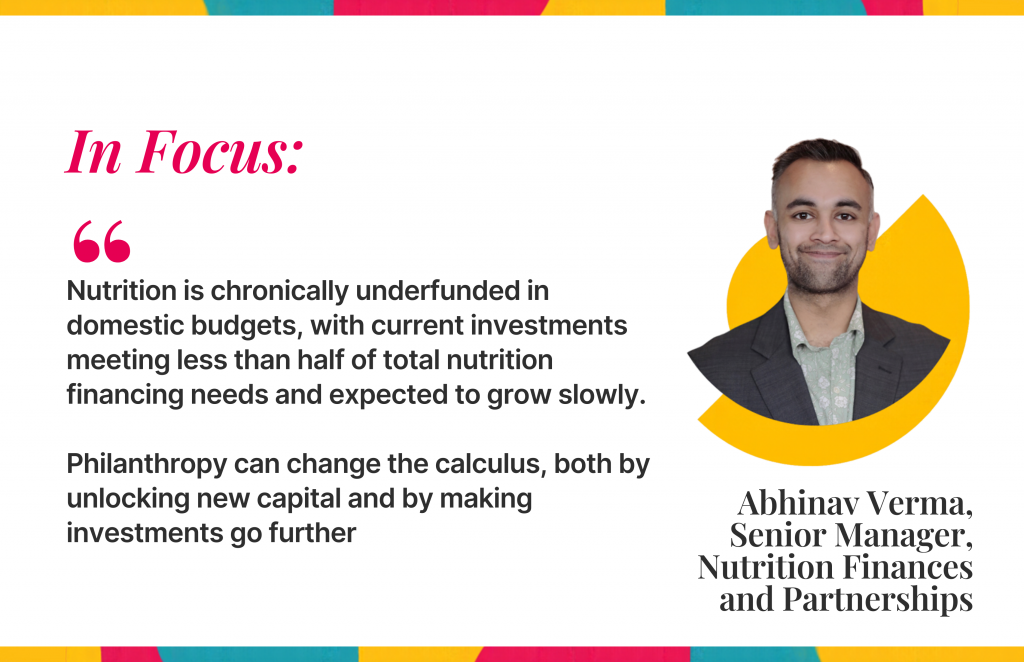
Abhinav Verma


Maternal nutrition supplements and therapeutic foods are proven to reduce child malnutrition, but they are not being distributed at sufficient scale. We asked Abhinav Verma, CIFF’s Senior Nutrition Financing and Partnerships Manager, to explain the blockers and how they can be overcome.
Today, almost half of all child deaths worldwide are linked to undernutrition. At the same time, well-nourished children are almost 20% more likely to read proficiently and 33% more likely to escape poverty as adults. These facts underscore a fundamental reality: we cannot build healthy or prosperous societies if our children and pregnant mothers are not well fed.
Years of research and product development have yielded effective, cost-efficient interventions, ranging from providing multiple micronutrient supplements to women during pregnancy to offering therapeutic foods to children already suffering from acute malnutrition. We have the tools to tackle this problem; the challenge is getting them off the shelf. Adequate financing and agile delivery systems are the primary challenges that stand in the way with conflict, climate shocks and economic crises complicating further.
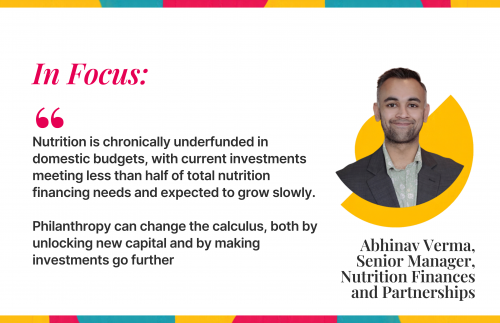
Nutrition is chronically underfunded in domestic budgets, with current investments meeting less than half of total nutrition financing needs and expected to grow rather slowly – from an estimated $4.5bn today to $6bn in 2034 per World Bank projections, covering barely a fifth of the financing needed to meaningfully scale proven solutions. With foreign aid budgets shrinking and debt burdens rising, countries find themselves in a fiscal quagmire, limiting their ability to scale up proven solutions.
This is where philanthropy can change the calculus, both by unlocking new capital and by making investments go further. The Child Nutrition Fund (CNF) – of which CIFF is a founding donor – is a prime example of this, allocating funding by matching domestic investments in nutrition commodities and programmes from governments of high-burden countries. This enhances both predictability and ambition, incentivising domestic sources of investment to eventually enable a smoother transition from external funding to sustainable, self-sufficient financing.
The approach is making a tangible difference in how funding is raised for treating malnutrition: by the end of 2025, 45 of the 63 eligible high-burden countries for CNF were drawing on its resources, mobilising approximately $673 million in additional government investments coming from their own budgets and loans from international financing institutions. This directly complements and aligns with government priorities and strengthens systems. For instance, in the Philippines, the CNF partnership builds on the First 1000 Days Law, directly contributing to the Philippine Plan of Action for Nutrition, and linking with PhilHealth, budget tracking, and the country’s MMS transition journey for a holistic effort on nutrition.
Since financing models like these unlock funding sources beyond just philanthropy, the CNF can channel more pure grant funding for countries with the highest level of need and lowest fiscal space, like Sudan, Yemen, and Afghanistan.
Even as these efforts broaden the pool of catalytic funding, it remains equally important to make every dollar go as far as possible, both in child nutrition and broader development. That is why it is critical to integrate nutrition with other critical health interventions, allowing governments to address overlapping health conditions as efficiently as possible and making it easier for beneficiaries to access essential care. In Ethiopia, for example, CNF and GAVI partnered to co-deliver on nutrition and immunizations at the same time, simultaneously screening over 700,000 children for malnutrition and distributing nutritional supplements to 25,000 children while providing essential jabs to 100,000 under-vaccinated children and registering those without birth certificates to link them to existing social protection systems.
The CNF is a model for development in 2026 because it tackles the financing crunch from both directions: generating new and sustainable funding while stretching the resources at our disposal as far as possible. We have the tools and we’re unlocking the funding – together we can put child malnutrition firmly in the past.
To learn more about progress on fighting maternal and child malnutrition, read the full 2025 Annual Report: CIFF: Our Year in Review 2025